12th April 2021 by Tadhg O’Mahony
The links between spatial and mobility planning, with sustainability and climate action, are increasingly coming up, in Ireland and beyond. We have ecological and climate emergencies widely acknowledged by science, but is this new reality now found in how we plan for settlement, and in our urban design, and in our transport systems?
There is a growing awareness, at the national level in Ireland, that the car-centred development and design we have embarked on, for a number of decades, are a costly folly, and deeply unsustainable. But is this awareness filtering through to local level? Are we putting in place the plans and strategies that are consistent with the challenges we have, and ultimately with delivering sustainability and wellbeing for our citizens?
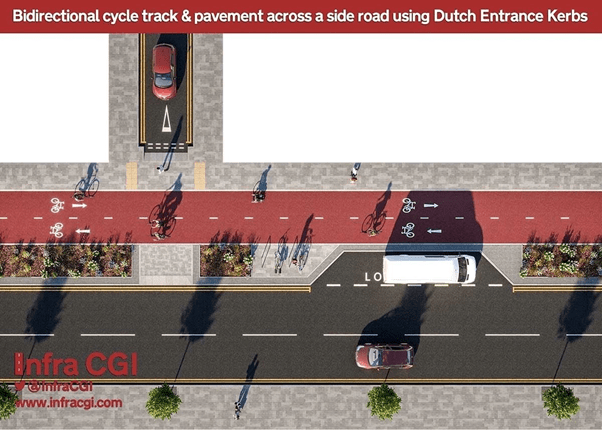
The Kilmainham and Inchicore Development Strategy (KIDS) was produced for Dublin City Council recently. The thought-provoking reflections of Lauren Tuite, entitled: “Family Life, Movement and Heritage,” are a useful and interesting example of how to engage with these topics. Lauren notes that the development strategy is light in a number of areas, including people and child-centred design, and especially on movement and linkages. Word analysis is used to clearly point to the priority on tourists, as consumers, rather than on the community and local people. When considering the assessment of the provision of cycle facilities, which are in fact bus lanes, it includes the withering assessment “paint is not infrastructure,” and continues to offer useful graphic examples of what segregated bicycle lanes look like.
To produce a development strategy, consistent with achieving wellbeing and sustainability, we need a clear understanding of the baseline, the challenges it presents, and the variety of opportunities available into the future. The KIDS appears inadequate in these respects. It lacks the type of framing required to anchor a comprehensive and desirable vision, and shows sub-par conclusions on mobility and infrastructure. The strategy refers to spatial, movement and linkage ‘analysis,’ but what is presented could scarcely be described as such. More fundamentally, the analysis, the priorities and the recommendations of the strategy, demonstrates not only little vision, but fundamentally reinforce the existing dynamics that continue to favour minority private wealthy interests. The report appears to use concepts such as ‘placemaking’ and ‘community’ as buzz words, and this masks a deepening of the status quo.
The strategy is effectively a rudimentary economic planning exercise, that prioritises the economic freedoms of private interests over those of the communities therein. Why are lands at Heuston -strategic priorities for national development of public transport infrastructure- recommended for housing development, while the strategy explicitly leaves privately-owned brownfield sites out of consideration? Where are the recommendations to consider other models of development, to prioritise community gain through housing cooperatives, rather than build-to-rent, student and hotel developments? These types of development now dominate construction in Dublin City, prioritising private profit-making over the citizen. This market-led approach pushes further upwards on already high property and rent prices, and drives the persistent scourge of homelessness in the city.
Relating to the poor spatial, movement and linkage analysis, why has Islandbridge not been identified as a new village in the area? Islandbridge has been a focus of considerable residential development in recent years, and would now constitute a village by any reasonable definition. Islandbridge is a strong example of car-centric urban design in Dublin. The ‘efficiency’ of vehicular traffic flow continues to be prioritised at the expense of a safe liveable community. Pedestrian and cycle facilities are very poorly provided for, making it difficult to safely reach any of the amenities in the area, particularly for those with limited mobility.
Recognising that there are now three high density villages in the area, when including Islandbridge, where are the comprehensive plans to connect them through active mode infrastructure? Where is the recommendation to link these with the nationally significant public transport hub at nearby Heuston station?
The strategy does note a number of important themes: ‘vision’…‘enhanced connections’…’15 minute city’… ‘well-being’… but it gives a distinct impression that these are more buzz-word rather than substantial considerations. It’s not clear that the strategy has done the analysis, or presented a real vision. The report has engaged with ‘stakeholders’ but this included only local and central government agencies and elected representatives, not the public or community leaders. The area has a number of bicycle shops, including Frontline Bikes, a social enterprise that helps people with substance addictions to find meaningful work in reclaiming bicycles ready for scrapping. Where is the vision to establish the area as a hub of the cycle economy, the kind that developed in Seville when cycling was prioritised? Where is the place for St. Patrick’s Athletic FC, as a prominent sports club in the area, that can help with social inclusion, physical wellbeing, and community-building?
Limited analysis and engagement, is often a precursor of limited vision and strategy. This strategy gives the impression of listing interesting themes, but of being an early draft, that has yet to journey through to completion. The strategy appears to have been led by commercial estate agents. It leaves a strong impression of a primary focus on real estate value, and tourism as a generator of economic activity. It does not grasp the real challenges, or the many opportunities. If there is a sense of disenfranchisement or social marginalisation amongst some communities, then a strategy such as this may provide some indication of why this occurs. The words ‘equity,’ ‘equality’ or ‘just’ do not feature anywhere. In that case, whose voice has been heard in this report? Is this result consistent with employing property estate agents -rather planners, urban designers, community developers and sustainability professionals- to produce it?
From the last election, the constituency subject to this strategy, Dublin South Central, is the most left-wing in the history of the state. If anywhere is ripe for leading the radical change necessary, throughout our communities, it is here. The Kilmainham-Inchicore-Islandbridge area, is ideal, to lead as an example of a sustainable city community of Northern Europe. A lot is required to move this strategy to a higher level of ambition, and a better vision for the thousands of people that live there.
 Dr Tadhg O'Mahony
Leave a comment